

Research release · September 4, 2026
Introducing FinIR
FinIR is a finance-aware intermediate representation and execution runtime for turning AI-interpreted financial instructions into deterministic, typed, and auditable computation. It does this without relying on generated Python, SQL, or spreadsheets as the execution layer.
By Lethabo Scofield and Alisha Fatima
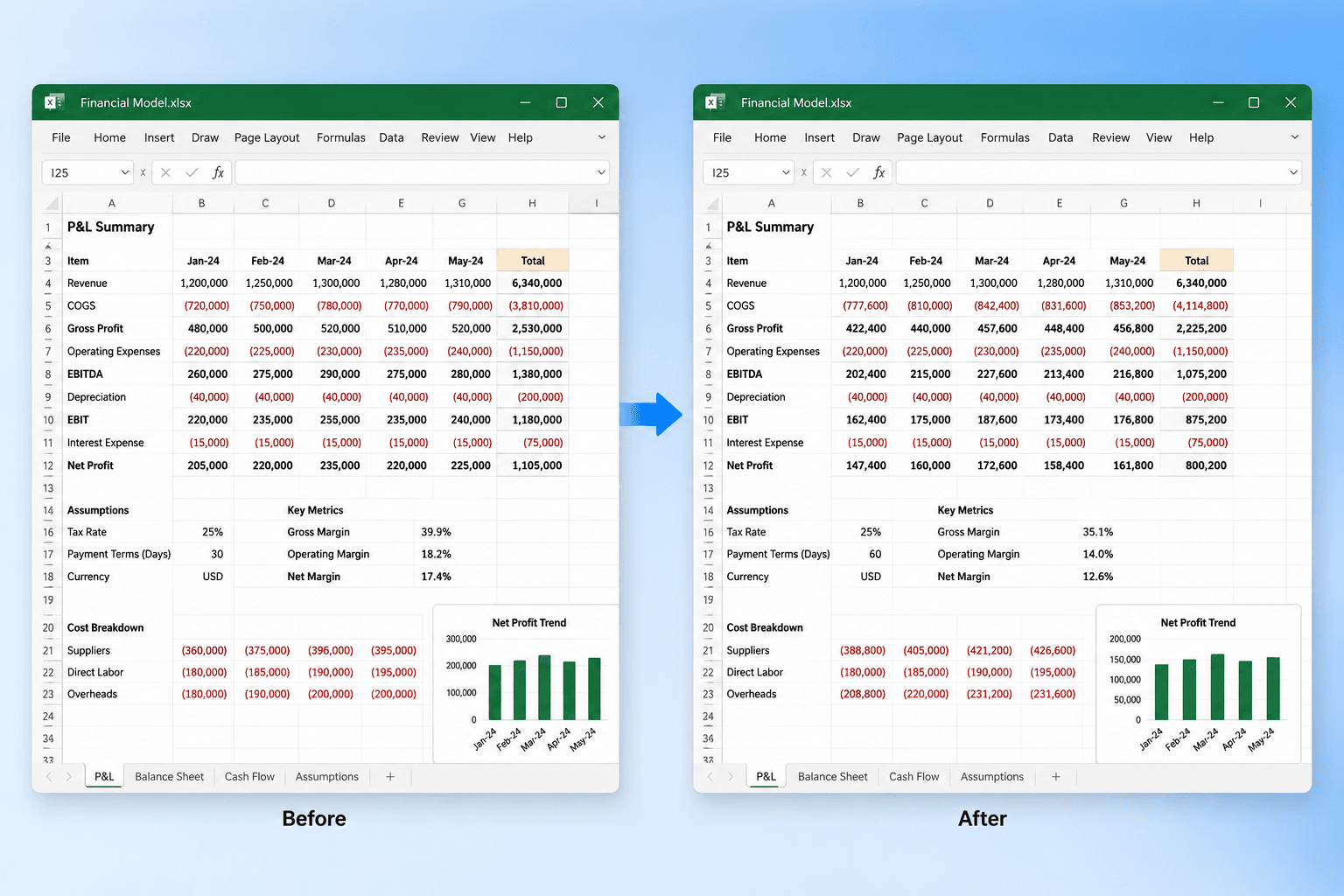
A reliable place for financial computation
AI systems are good at interpreting financial instructions, but interpretation is not the same as reliable execution. When an AI generates Python, SQL, or spreadsheet formulas for every task, the execution logic can change between runs, financial types are difficult to enforce, and the origin of each result becomes harder to audit.
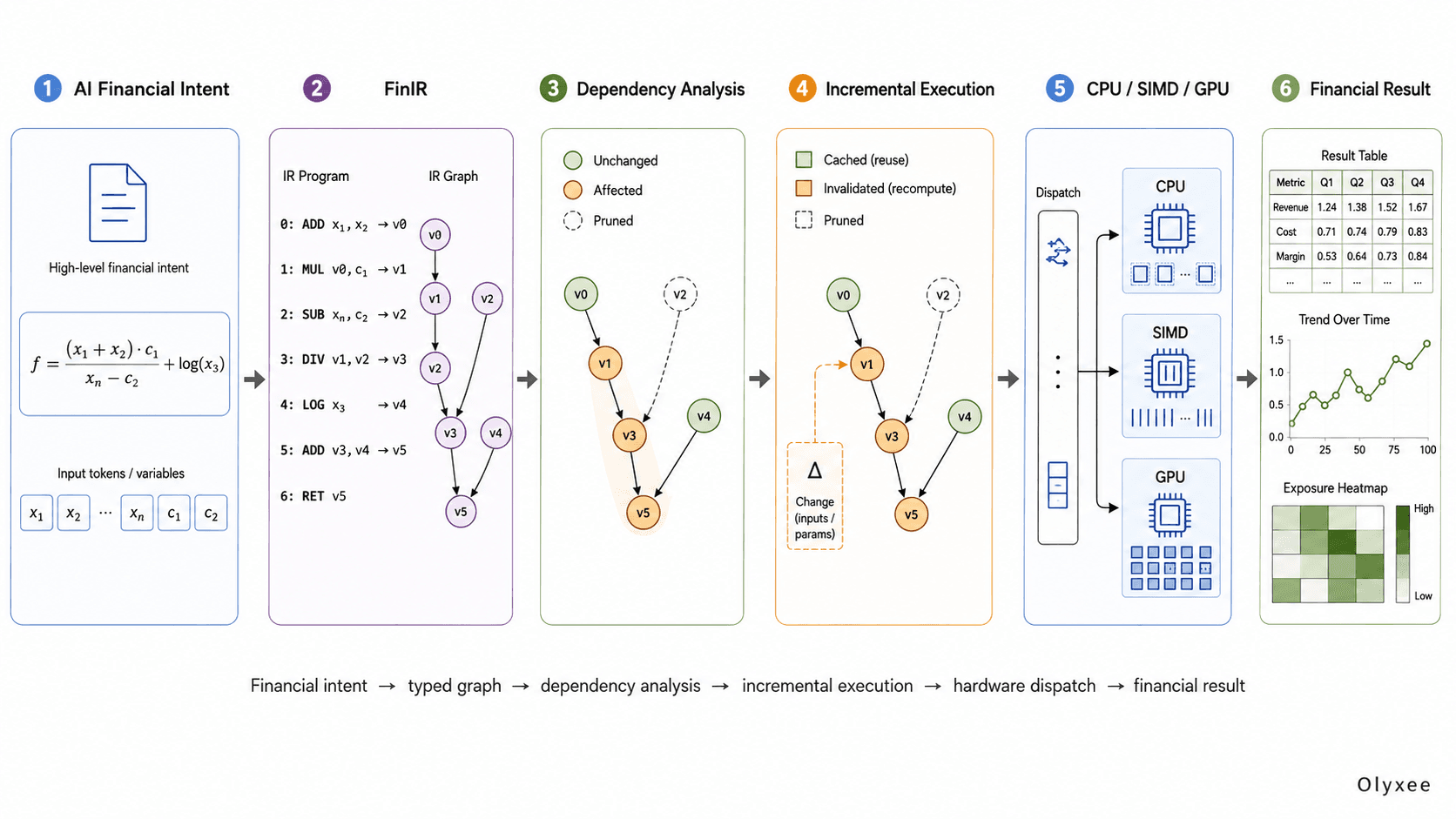
FinIR addresses this problem by placing a deterministic computational layer between the AI and the final result. The AI expresses financial intent, while FinIR validates the types, records the dependencies, compiles the computation, and recalculates only the values affected by a change.
A computational boundary for AI
FinIR separates probabilistic interpretation from deterministic financial execution.
How FinIR works
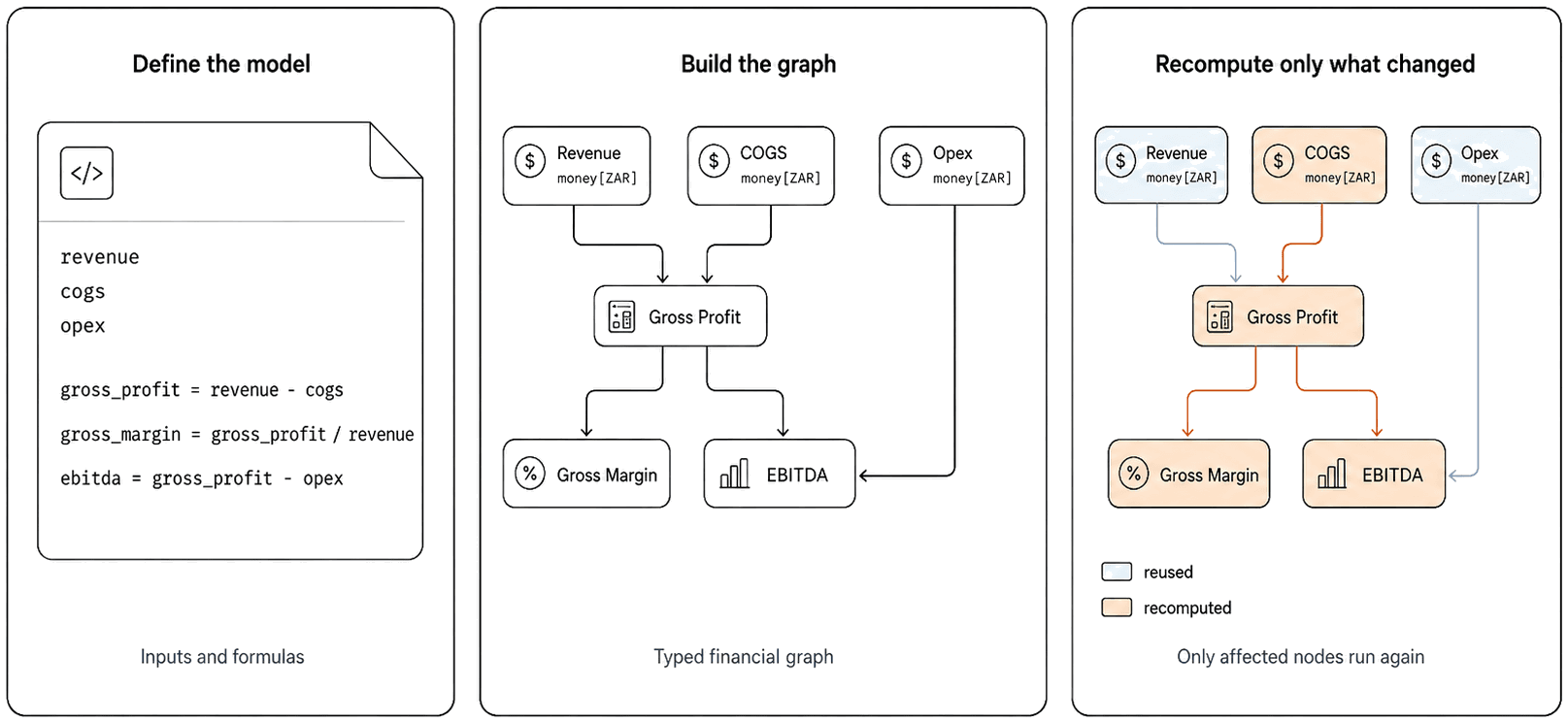
You describe a financial model once. FinIR turns it into a graph of typed calculations and runs that graph directly, so there is no generated Python, SQL, or spreadsheet in between.
Finance-aware type semantics
In a spreadsheet, every cell is just a number. FinIR gives every value a financial type, so the engine knows what a cell means before it computes it. Valid formulas keep their meaning; formulas that mix incompatible meanings are stopped with an error instead of producing a wrong number.
- RevenueFormulainputTypemoney[ZAR]ResultR 1,200,000
- COGSFormulainputTypemoney[ZAR]ResultR 720,000
- Gross ProfitFormulaRevenue − COGSTypemoney[ZAR]ResultR 480,000
- Gross MarginFormulaGross Profit ÷ RevenueTyperatioResult40.0%
- Receivable daysFormulainputTypedaysResult45 days
- Revenue + daysFormulaRevenue + Receivable daysTypemoney + daysResult#TYPE_ERRORYou cannot add money to days.
- USD + ZARFormulaUS Revenue + RevenueTypeUSD + ZARResult#CURRENCYCurrencies must match.
FinIR ships with money, percentage, ratio, days, quantity, rate, series, scenario, scalar, and boolean types. Money arithmetic requires matching currencies, and adding money to days fails loudly rather than returning a plausible-looking figure.
Compiler and evaluate flow
Before any number is produced, FinIR compiles the model. It first validates the module, checking that every referenced name exists and that the graph has no cycles. It then type-checks each expression using the finance-aware rules above, so a currency mismatch or a money-plus-days formula is caught here, once, rather than at the point of use. Only a model that passes both stages can be evaluated.
Evaluation is target-driven. When you ask for EBITDA, the engine plans the minimal set of nodes that EBITDA depends on, orders them so each dependency is computed before the node that needs it, and hands the arithmetic to a backend. It returns the requested values together with runtime statistics, such as how many nodes were computed and how many were reused from cache, so every result is accompanied by an account of the work done to produce it.
The compiler also defines a set of optional analysis and transformation passes for ahead-of-time compilation: constant folding, common-subexpression elimination, dead-node elimination, dependency pruning, scenario-vectorization analysis, fusion analysis, and cache planning. Running finir compile shows each pass and its effect on the graph. Interactive models keep validation and type checking on every change but retain queryable, human-readable node names so results can always be traced back to the model as written.
Incremental runtime
The runtime maintains a value store and validity set. Changing an input invalidates its downstream cone using precomputed dependents. Evaluation walks needed nodes in dependency order: valid nodes are reused by lookup; invalid nodes are recomputed and marked valid.
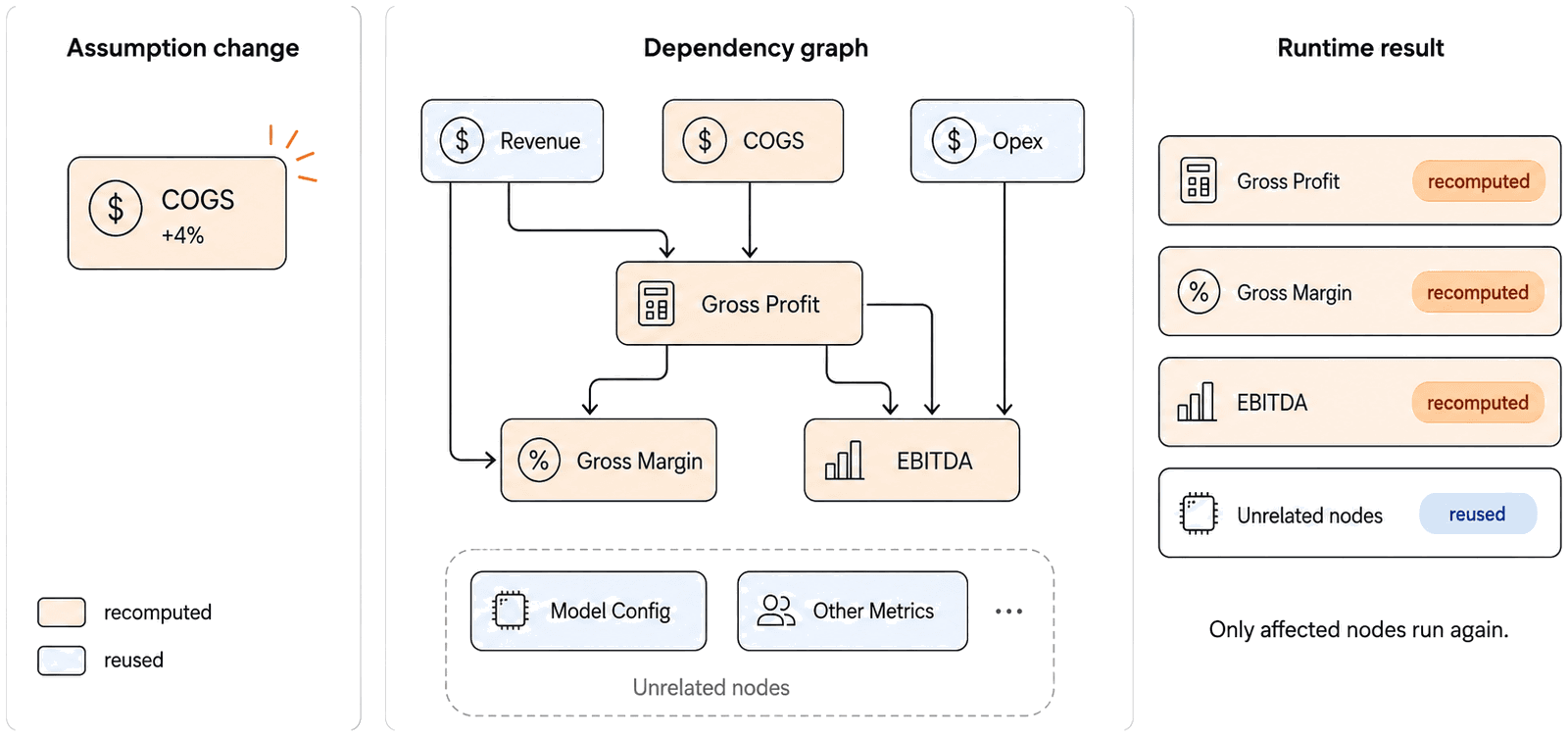
The repository also exposes transient what-if evaluation, state snapshots, and cache-hit metrics.
Evidence and reproducibility
Experiment 001 asks whether dependency-aware caching reduces the cost of iterative financial reasoning. Its 1,000-turn synthetic workload uses a 6-node model and compares a warm FinIR cache with a same-engine baseline whose cache is cleared each turn.
- Time
- 0.0355s
- Recomputes
- 6,000
- Cache hit
- 0%
- Time
- 0.0223s
- Recomputes
- 3,600
- Cache hit
- 40.0%
| Condition | Time | Recomputes | Cache hit |
|---|---|---|---|
| Baseline, full recompute | 0.0355s | 6,000 | 0% |
| FinIR incremental | 0.0223s | 3,600 | 40.0% |
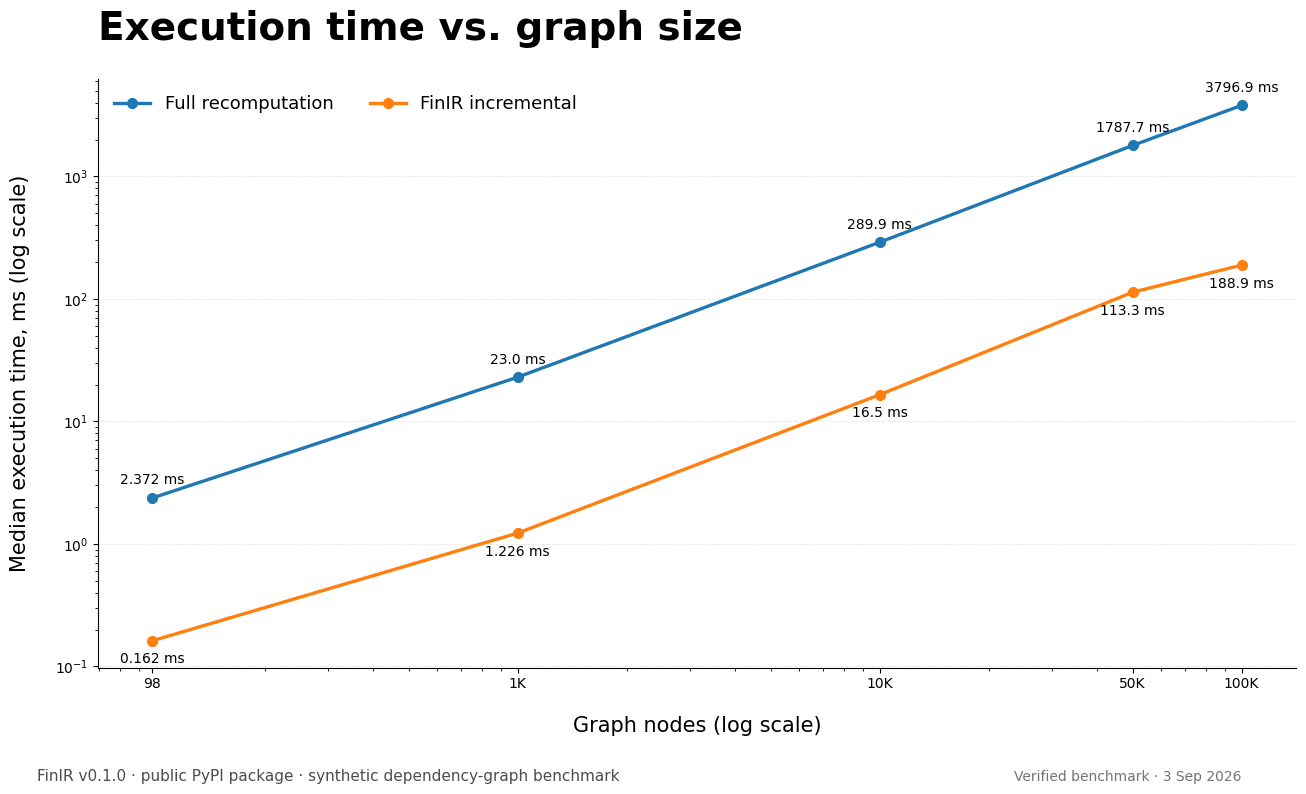
Observed in this run: 1.59×. This is a synthetic workload, with cheap arithmetic and Python traversal overhead, run in a single CPU process using the same engine and no-cache baseline. It is not a general production speedup claim. Reproduce with python research/reproduce_experiment_001.py in the public repository.
How the execution models compare
The table below compares typical out-of-the-box execution models, not measured runtime speed. Products and custom implementations vary; external tools were not included in Experiment 001.
FinIR
- Finance-aware types
- Built in
- Incremental recomputation
- Built in
- Dependency graph
- Built in
- AI execution boundary
- Designed for it
Spreadsheets
- Finance-aware types
- Limited
- Incremental recomputation
- Common, implementation-dependent
- Dependency graph
- Implicit cell graph
- AI execution boundary
- Not by default
Generated Python / SQL
- Finance-aware types
- Custom code required
- Incremental recomputation
- Custom code required
- Dependency graph
- Not by default
- AI execution boundary
- Generated code executes directly
Generic DAG tools
- Finance-aware types
- Custom domain layer required
- Incremental recomputation
- Tool-dependent
- Dependency graph
- Built in
- AI execution boundary
- Custom integration required
| Approach | Finance-aware types | Incremental recomputation | Dependency graph | AI execution boundary |
|---|---|---|---|---|
| FinIR | Built in | Built in | Built in | Designed for it |
| Spreadsheets | Limited | Common, implementation-dependent | Implicit cell graph | Not by default |
| Generated Python / SQL | Custom code required | Custom code required | Not by default | Generated code executes directly |
| Generic DAG tools | Custom domain layer required | Tool-dependent | Built in | Custom integration required |
Limitations and boundaries
FinIR is a compiler target and runtime for financial computation. It is not a dashboard, ERP, trading platform, quant library, or generic DAG engine. This release makes no novelty, first, or breakthrough claim.
Experiment 001 is one synthetic graph and one CPU, with no engine-level parallelism. Experiment 002 does not verify a GPU crossover; its GPU_MIN_ELEMENTS = 250_000 threshold is a heuristic placeholder. The repository describes a CPU-first reference/vectorized backend and an optional CuPy GPU backend; this page does not claim shipping CPU, SIMD, or GPU acceleration beyond that status.
Install and get started
The public package is FinIR 0.1.0, released August 31, 2026. Install the CPU-first package with:
 Python 3.10+Terminal
pip install finirpython -c "import finir; print(finir.__version__)"finir --helpfinir doctor
The repository also documents optional gpu and viz extras and editable development installation. The canonical company model and exact .finir syntax are available in the repository’s examples/company_model/model.finir.
References and resources
Primary materials for inspecting the release, reproducing the reported experiment, and working with the public package.
Each link opens the original source in a new tab.
Start with the release
The repository, installable package, and versioned release record.


Read the technical record
Documentation for the representation, validation rules, compiler, and runtime.
Inspect evidence and related work
Experiment materials, the released model, and the public benchmark dataset.
 FinIR-IntentThe FinIR-Intent resource on Hugging Face.Open FinIR-IntentFinIR-IntentBenchThe public IntentBench evaluation dataset on Hugging Face, with core and stress splits.Open FinIR-IntentBench